We pointed our competitor monitor at our own market for seven weeks. Two things held up.
August 27, 2026 · Bobby Cavezza
One baseline email, five consecutive weekly updates, one same-day alert, and one later weekly digest told a more useful story than a pile of page diffs: AlphaSense kept compounding into the clearest strategic move in the market, and Delta Rival also surfaced a direct pricing threat fast enough to matter.
When you write about your own product, the credibility bar gets higher.
So this is not a customer case study.
It is a dogfooding teardown based on one inbox, one category, and a time window I chose myself.
I took one baseline email, five consecutive weekly Delta Rival updates, one same-day alert, and one later weekly digest from my own inbox and read them in order. The question was simple: would they sharpen my view of the market, or just hand me a noisy archive of competitor changes?
The honest answer is that one storyline kept compounding, one interrupt was genuinely useful, and the rest of the value came from restraint.
That is the standard I want from a competitor monitor.
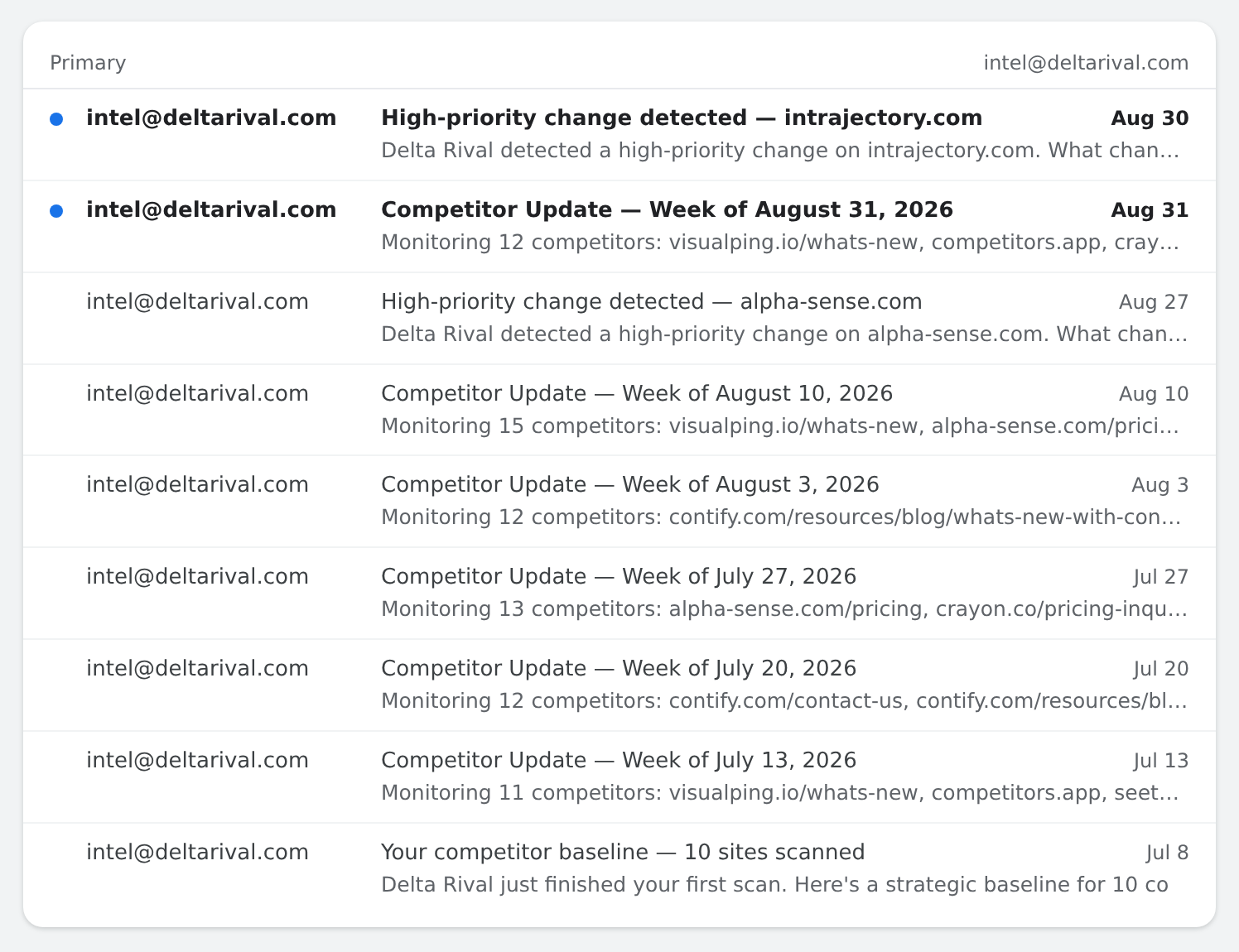
The actual intel@ inbox for this test. Baseline, five weeklies, two same-day alerts, then the Aug 31 digest.
What I wanted this test to prove
The test was not whether Delta Rival could detect page changes. Plenty of tools can do that.
The harder standard was this:
- identify the one move that mattered most that week
- explain why it mattered in plain English
- avoid manufacturing a story when the evidence was thin
- surface an urgent change fast enough that I would care before the next digest
Delta Rival's live promise is modest and specific: a weekly AI-analyst digest, same-day alerts on big moves, and a founder-friendly offer — 14-day free trial, no credit card, $79/month after that, cancel anytime.
This sample was still small. It covered one baseline email, five consecutive weekly updates, one same-day alert, and one later weekly digest. One forwarded July 27 email was a duplicate, and I am not counting it separately.
The main storyline: AlphaSense kept building a harder company to ignore
The strongest insight in the whole set was not one alert.
It was accumulation.
Across the weekly sequence, Delta Rival kept returning to the same conclusion: AlphaSense looked like the only competitor in this set making a coherent, multi-signal go-to-market move.
Not just self-serve. Not just enterprise. Both.
That was the useful part.
July 13: the first coordinated signal
In the July 13 update, Delta Rival flagged AlphaSense's vertical pages, AI content, and trial-request infrastructure as the top move of the week.
Any one of those changes alone could be random housekeeping.
Together, they suggest coordinated intent across SEO, product packaging, and conversion. That was the first week where the product stopped sounding like a tracker and started sounding like an analyst.
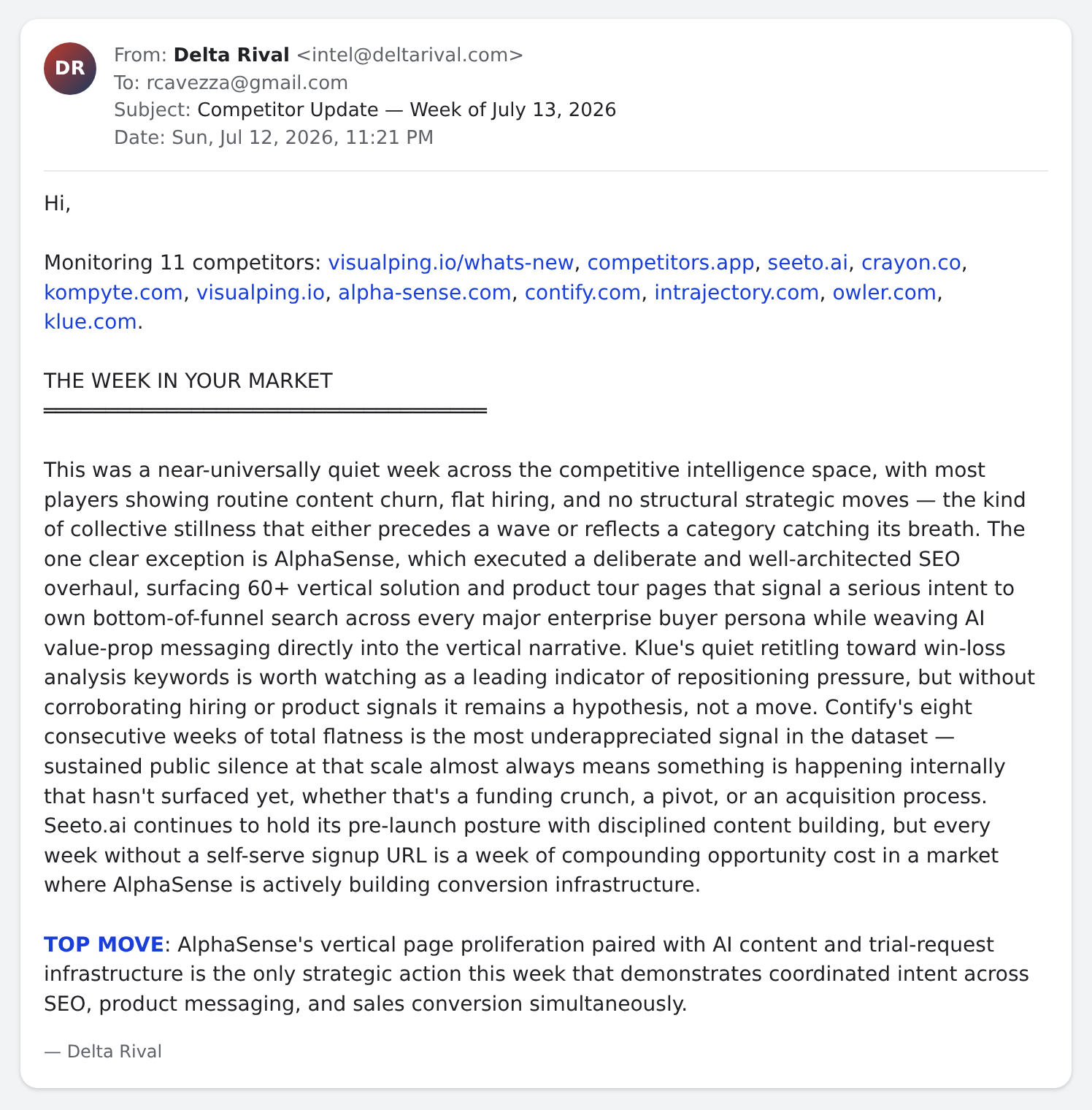
July 13 opens as a quiet week. Then AlphaSense drops 60+ vertical pages.
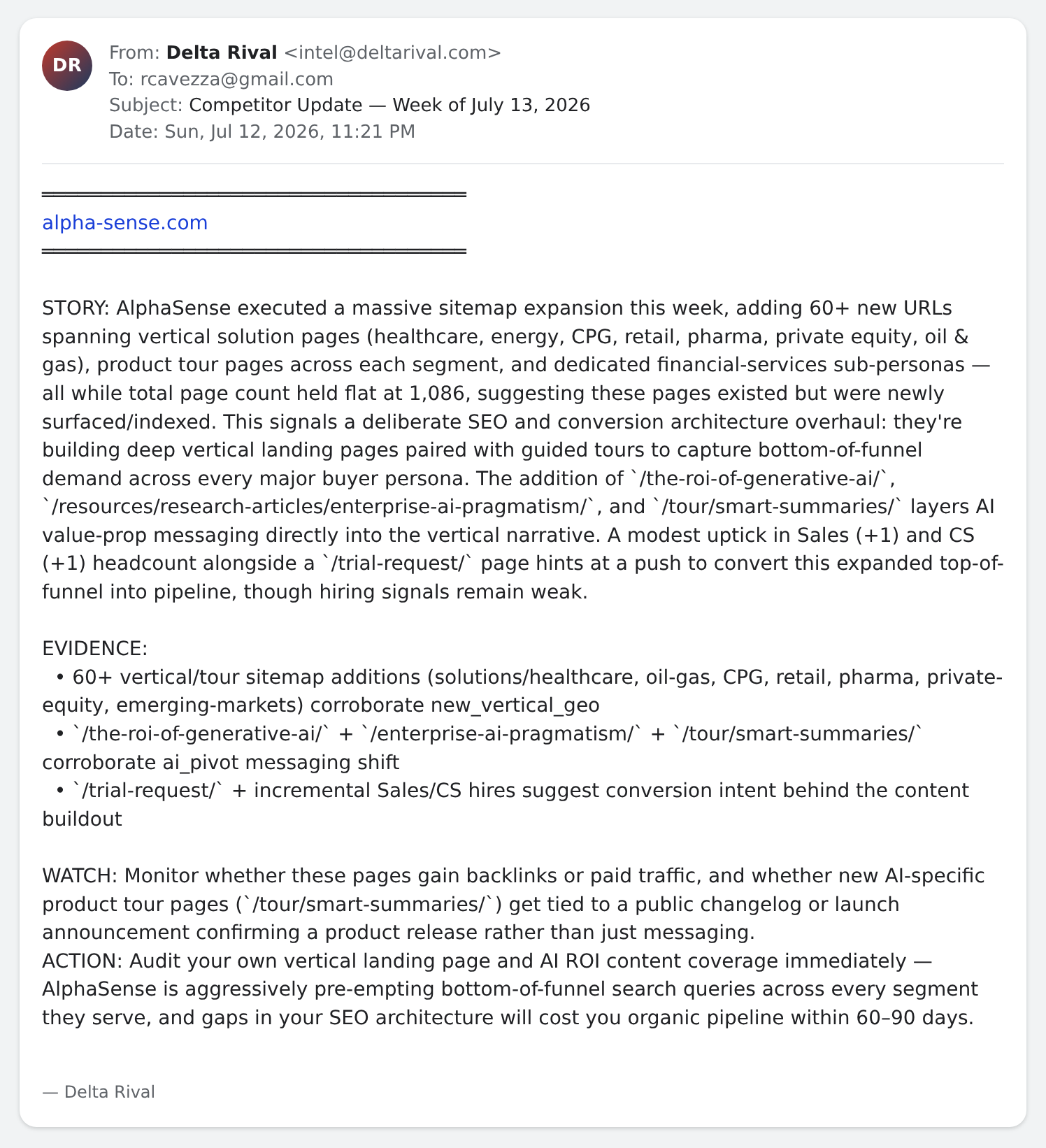
The July 13 AlphaSense story: 60+ vertical and tour URLs, page count still 1,086.
July 20: the positioning got sharper
A week later, the read became more specific.
Delta Rival framed AlphaSense as moving toward an end-to-end research-to-deliverable workflow, with PowerPoint and Excel integration as the notable signal. That matters because it points to workflow ownership, not just feature expansion. It suggests a company trying to become the system people work inside, not just a source they check.
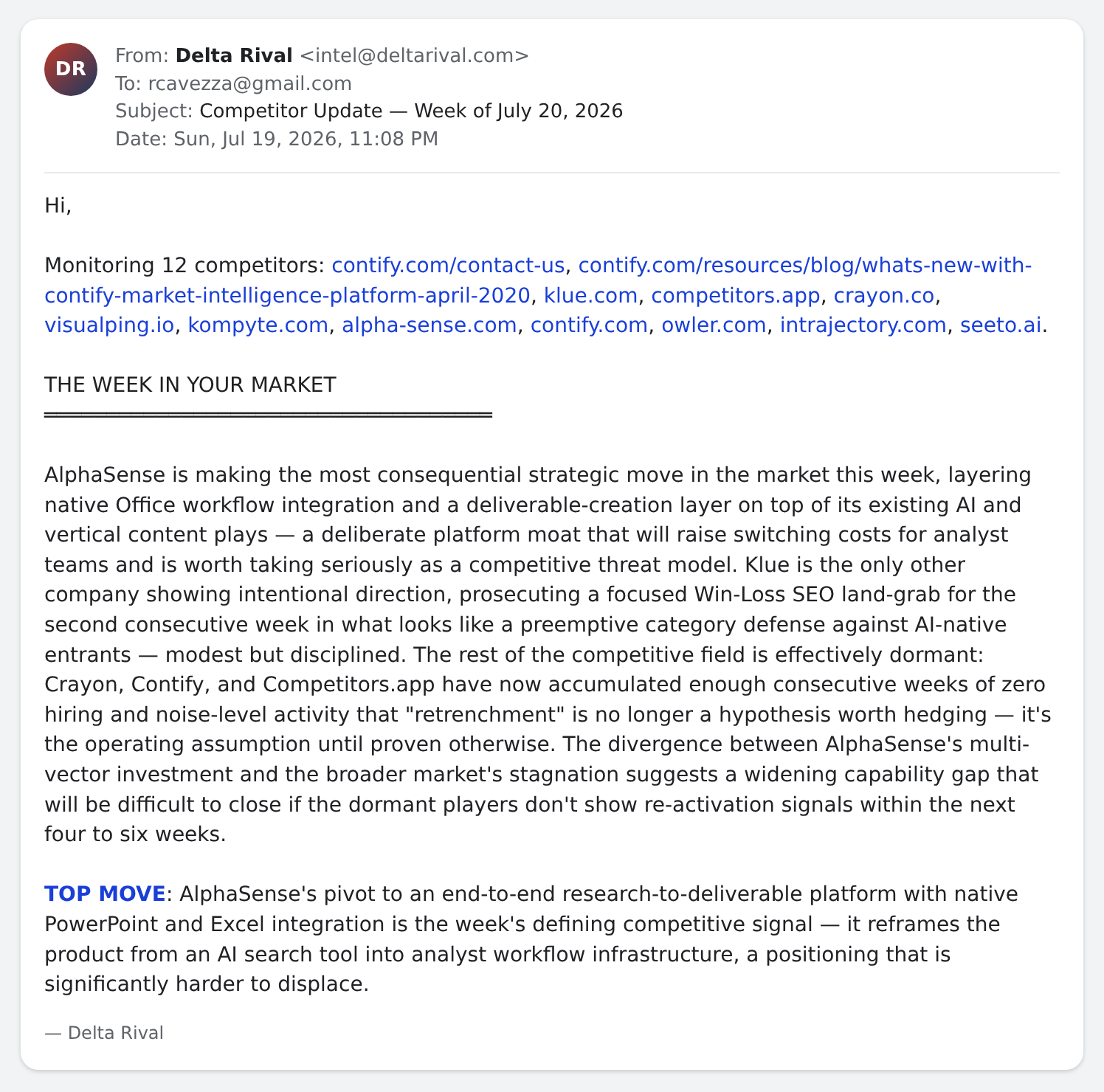
July 20 top move: AlphaSense is no longer a search box. PowerPoint and Excel are the product.
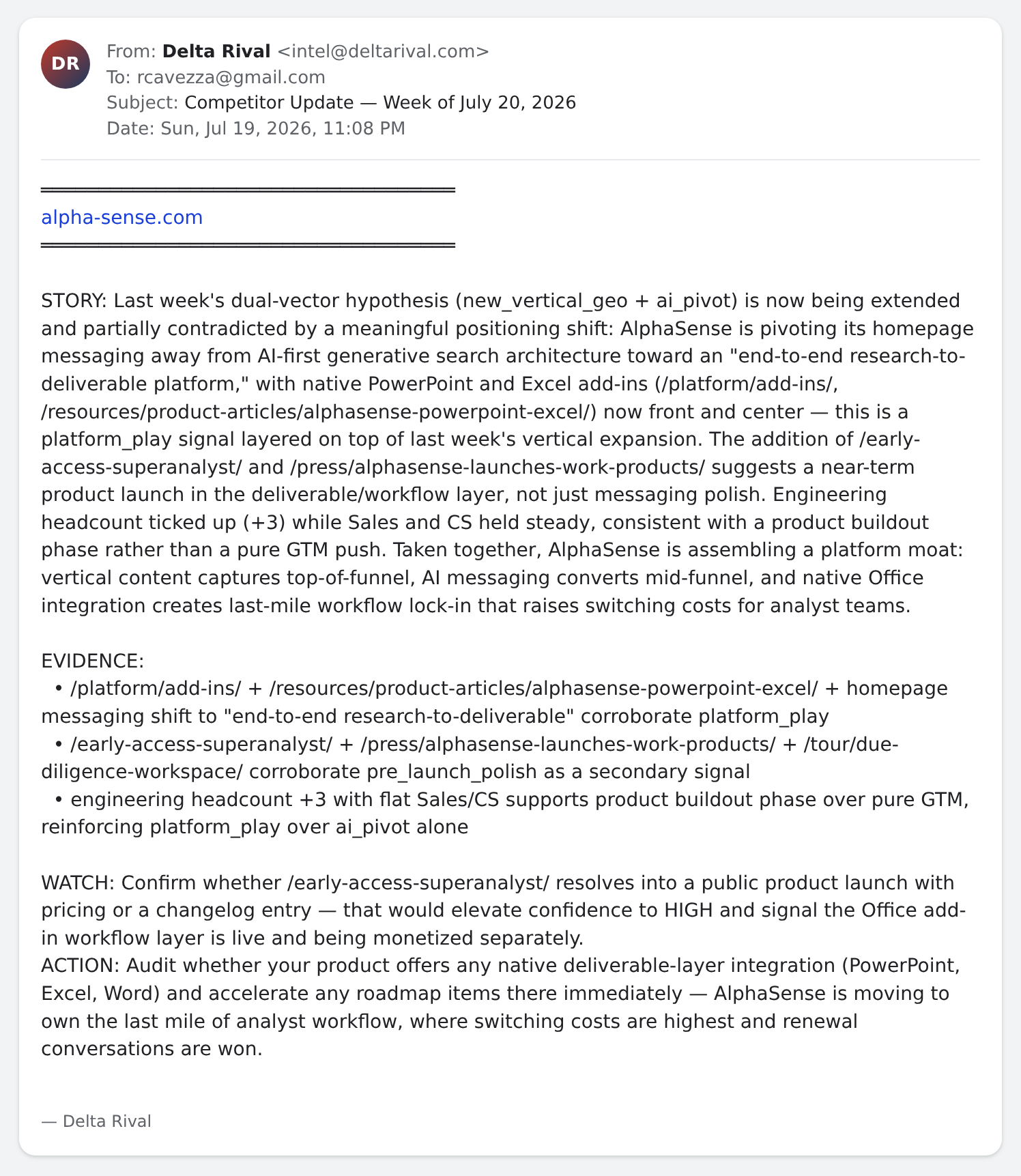
Research-to-deliverable on the homepage, native Office add-ins underneath.
July 27: the funnel and the enterprise layer became visible at the same time
The July 27 update is where the pattern became hard to dismiss.
Delta Rival surfaced buyer-segment pages, a self-serve trial funnel, and SuperAnalyst early access. In the same stretch, it also flagged a pricing-page rewrite with more enterprise security and compliance detail.
That is what made the storyline credible.
If you only saw buyer pages and trial flow, you might call it a self-serve push. If you only saw security and compliance detail, you might call it enterprise repositioning.
Seeing both at once suggests something more interesting: AlphaSense was building a barbell motion, with lower-friction entry at one end and heavier enterprise readiness at the other.
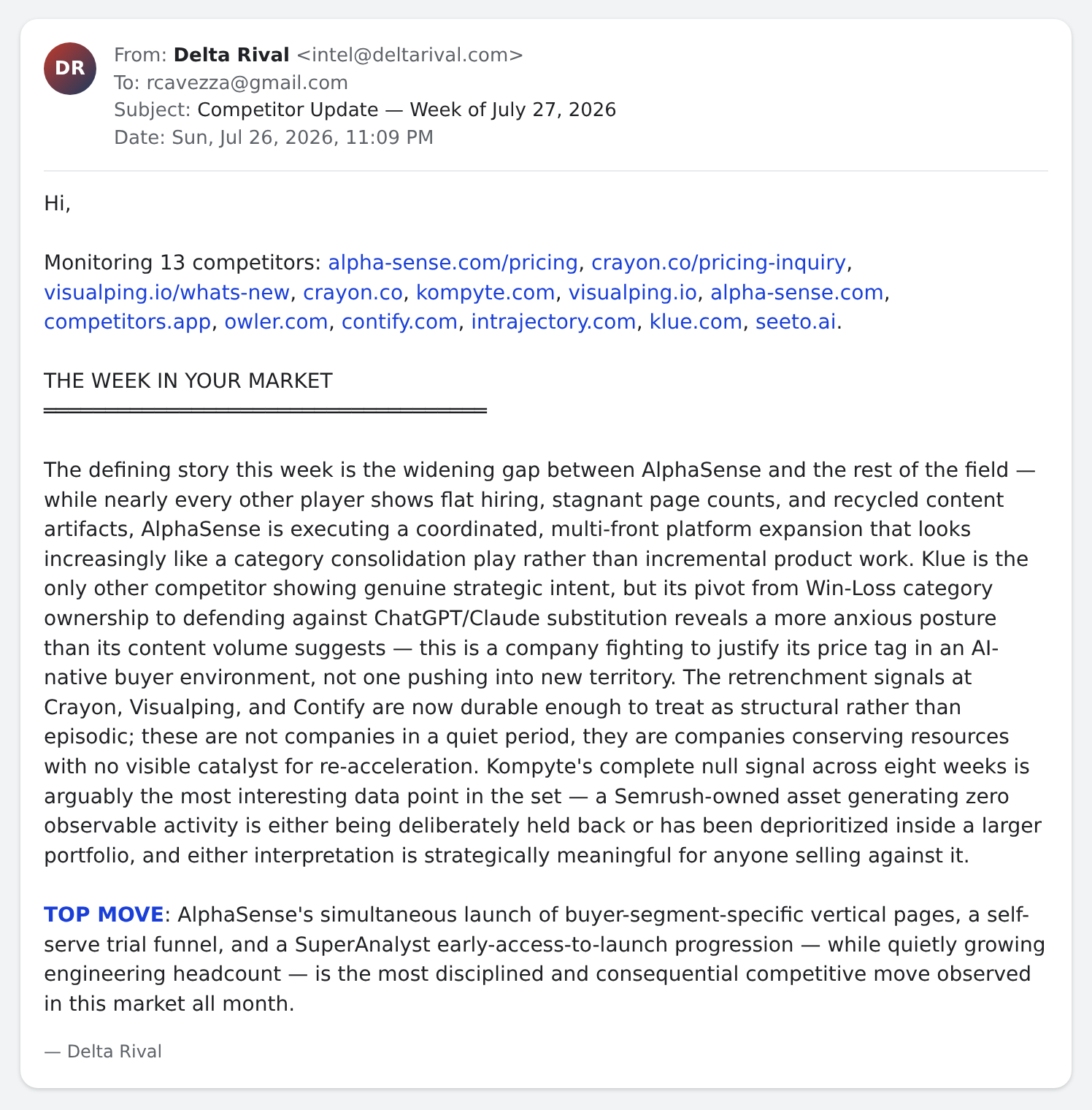
July 27: AlphaSense on a multi-front expansion. Almost everyone else is flat.
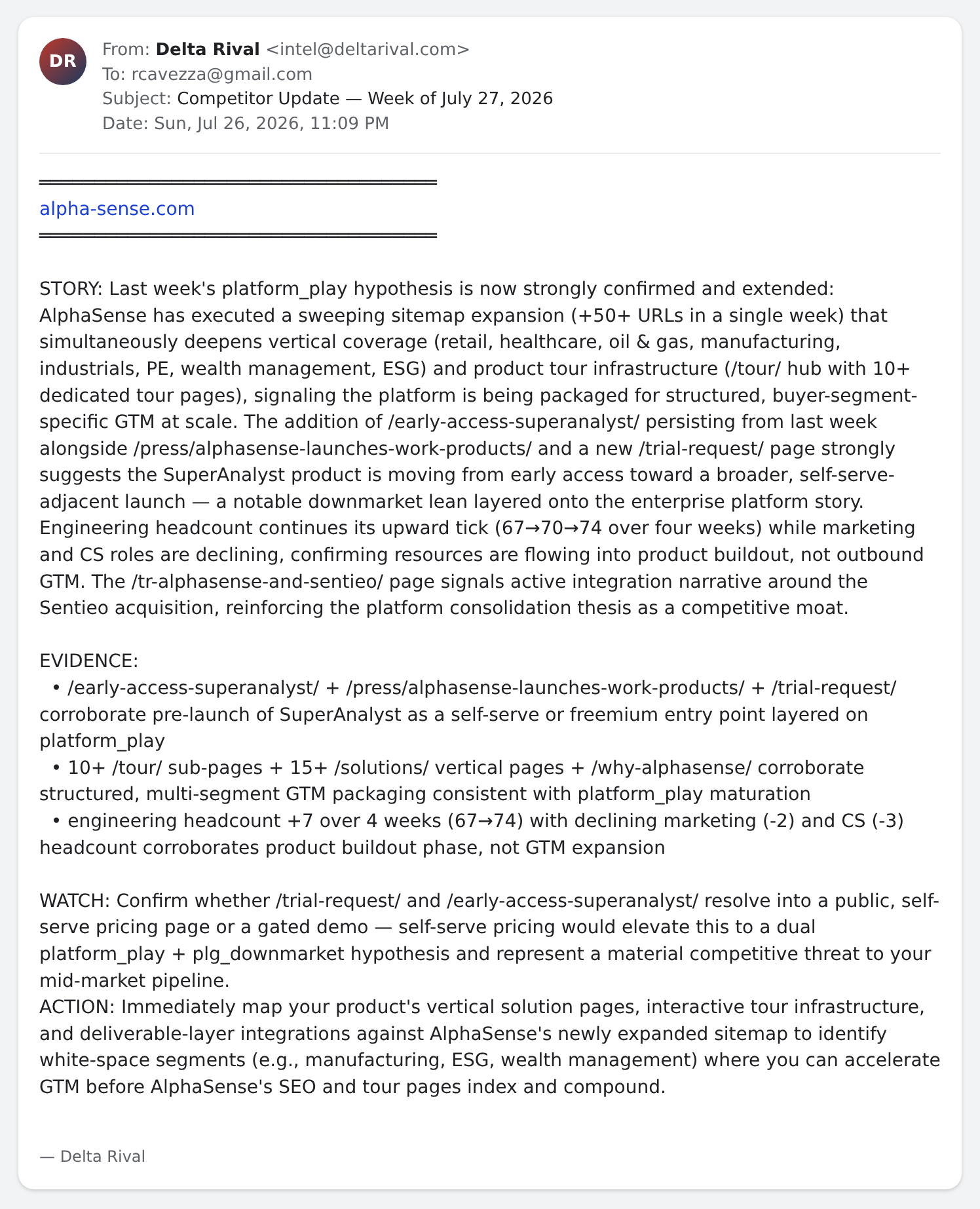
Buyer-segment tours, trial-request, SuperAnalyst, engineering 67 to 74. CS is shrinking.
August 3: the thesis did not need to advance to stay credible
This is the week that made the whole sequence more believable.
The August 3 digest did not force a new hero story just to make the email feel full.
Klue looked coherent around AI, but Delta Rival did not upgrade that into a bigger market thesis because there was not enough fresh corroboration. competitors.app was still flat and low-signal. In other words, the product let a quiet week stay quiet.
That matters.
A competitor monitor earns trust partly by what it declines to dramatize.
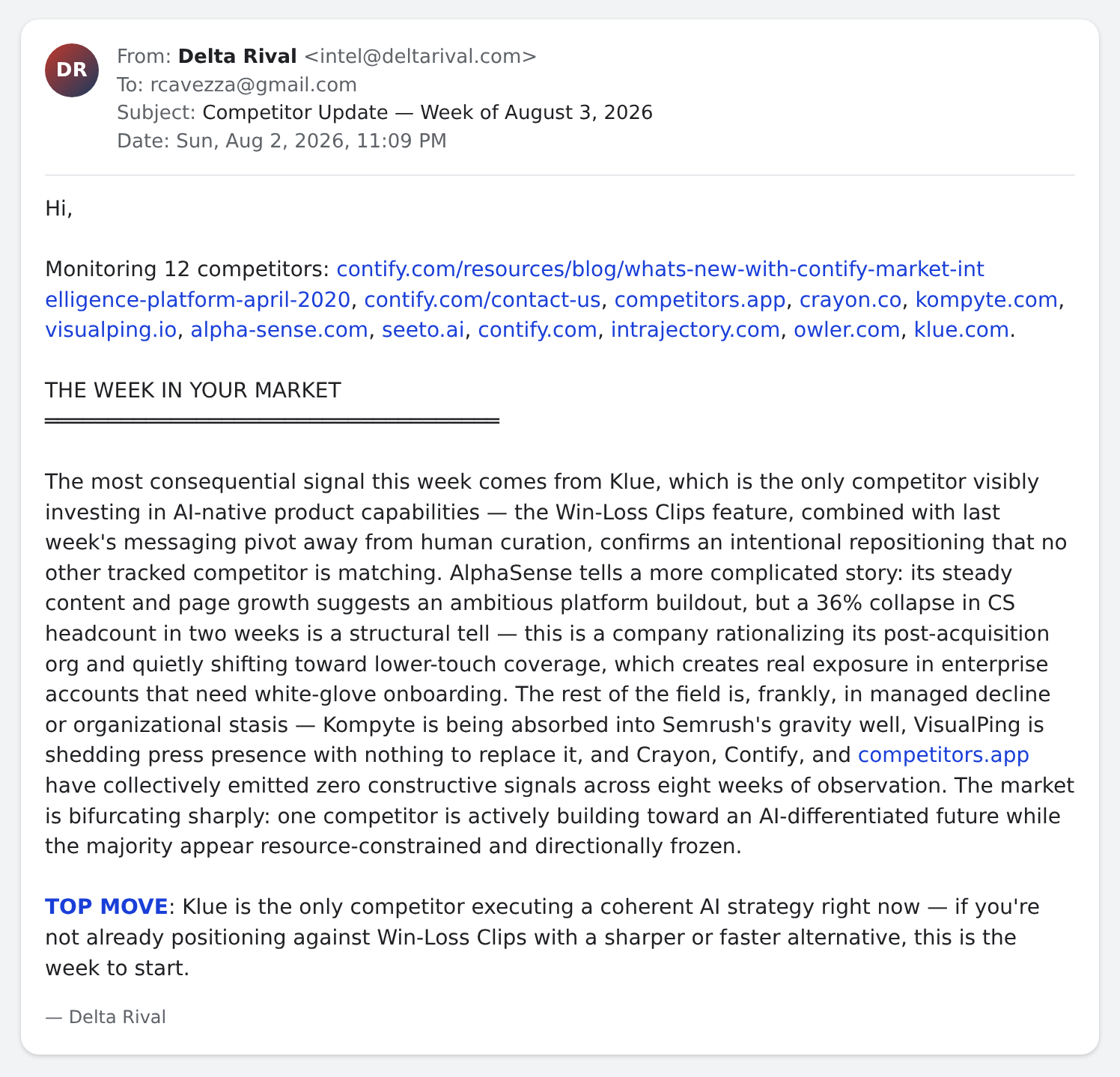
August 3 top move is Klue Win-Loss Clips. AlphaSense is not the only story this week.
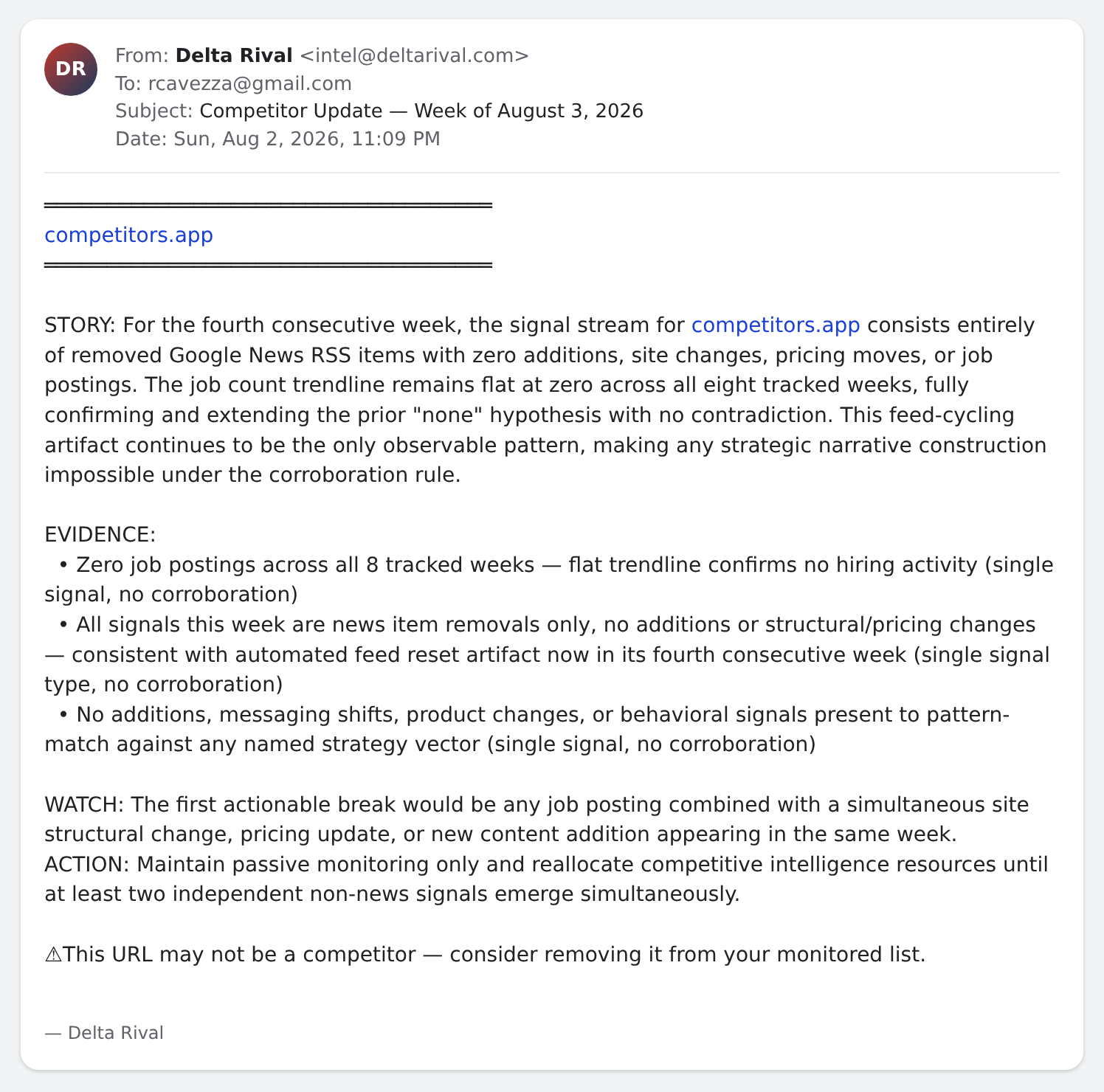
competitors.app is still just removed Google News items. The product left a quiet week quiet.
August 10: the org chart started matching the website
By August 10, the AlphaSense read had another layer behind it: enterprise AE hiring, pre-sales bench-building, and continued content expansion.
That is where the sequence becomes operationally useful.
A page-diff tool can tell you a pricing page changed. A useful market read connects site changes, hiring patterns, and message shifts into one evolving commercial story.
By the end of this stretch, the AlphaSense signal did not look like isolated churn. It looked like a company building a lower-friction funnel while also strengthening its enterprise sales motion.
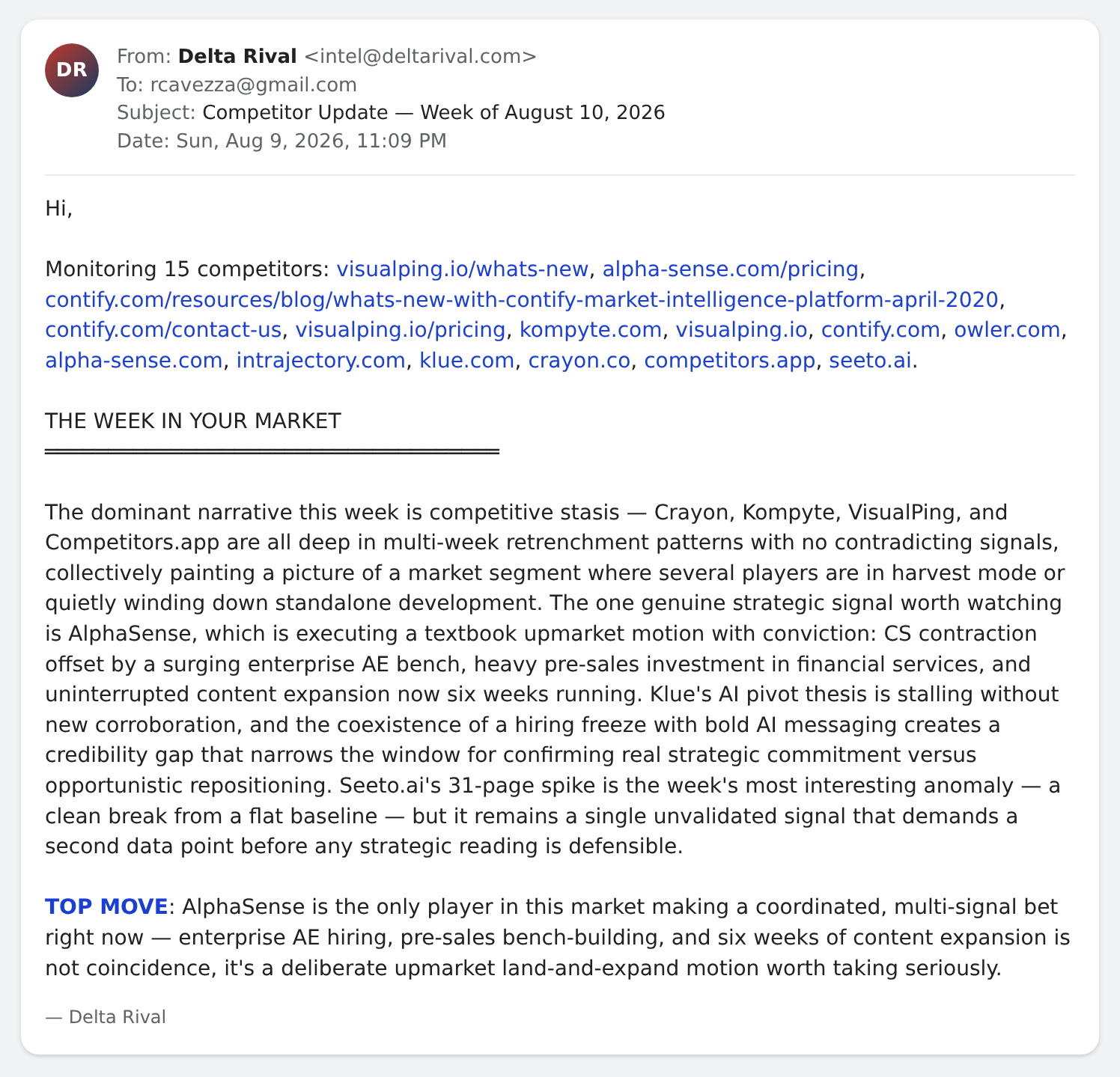
August 10 still calls AlphaSense the upmarket bet: sales 37, CS stuck below baseline.
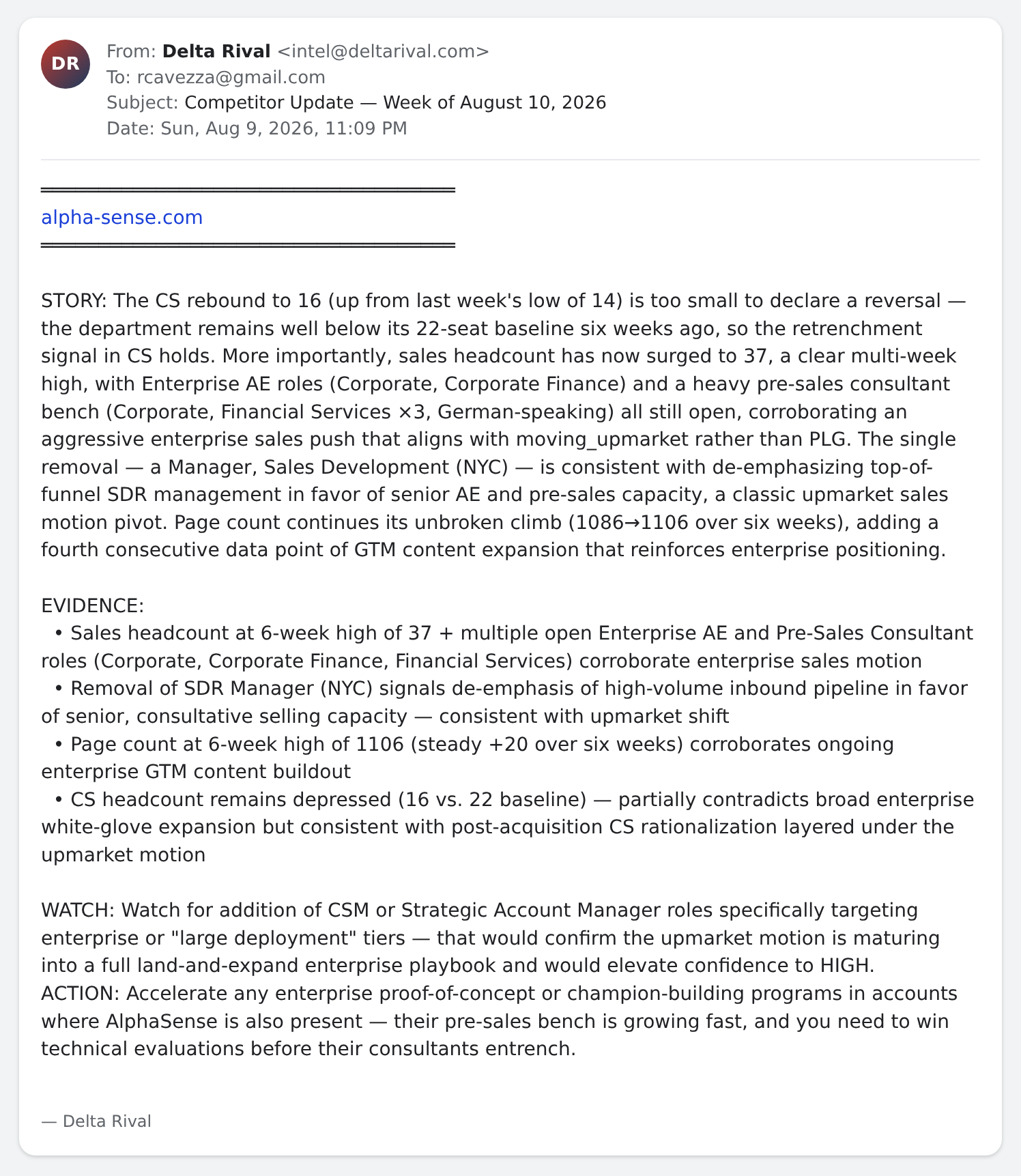
Enterprise AE and pre-sales consultants up. CS at 16 vs a 22-seat baseline.
August 30 and 31: the storyline held, and the alert layer earned its keep
Two later emails made the case stronger rather than just longer.
First, a same-day alert flagged that Intrajectory had published a fully structured pricing page with transparent tiers at $49, $99, $199, and enterprise pricing from $1,000 per month, each paired with a 14-day free trial.
Of course a same-day alert will beat a weekly digest on speed. That is arithmetic, not magic. The real question is whether this particular change was worth the interruption.
I think yes.
A competitor moving to transparent self-serve pricing in the same founder buying zone is not just a page diff. It changes the comparison set immediately.
It also forced an uncomfortable but useful reaction from me: the alert was about a competitor undercutting Delta Rival's $79 price with a $49 entry tier. That is exactly the kind of market move I would want surfaced quickly if I were the founder deciding how to position, price, and answer comparisons this week.
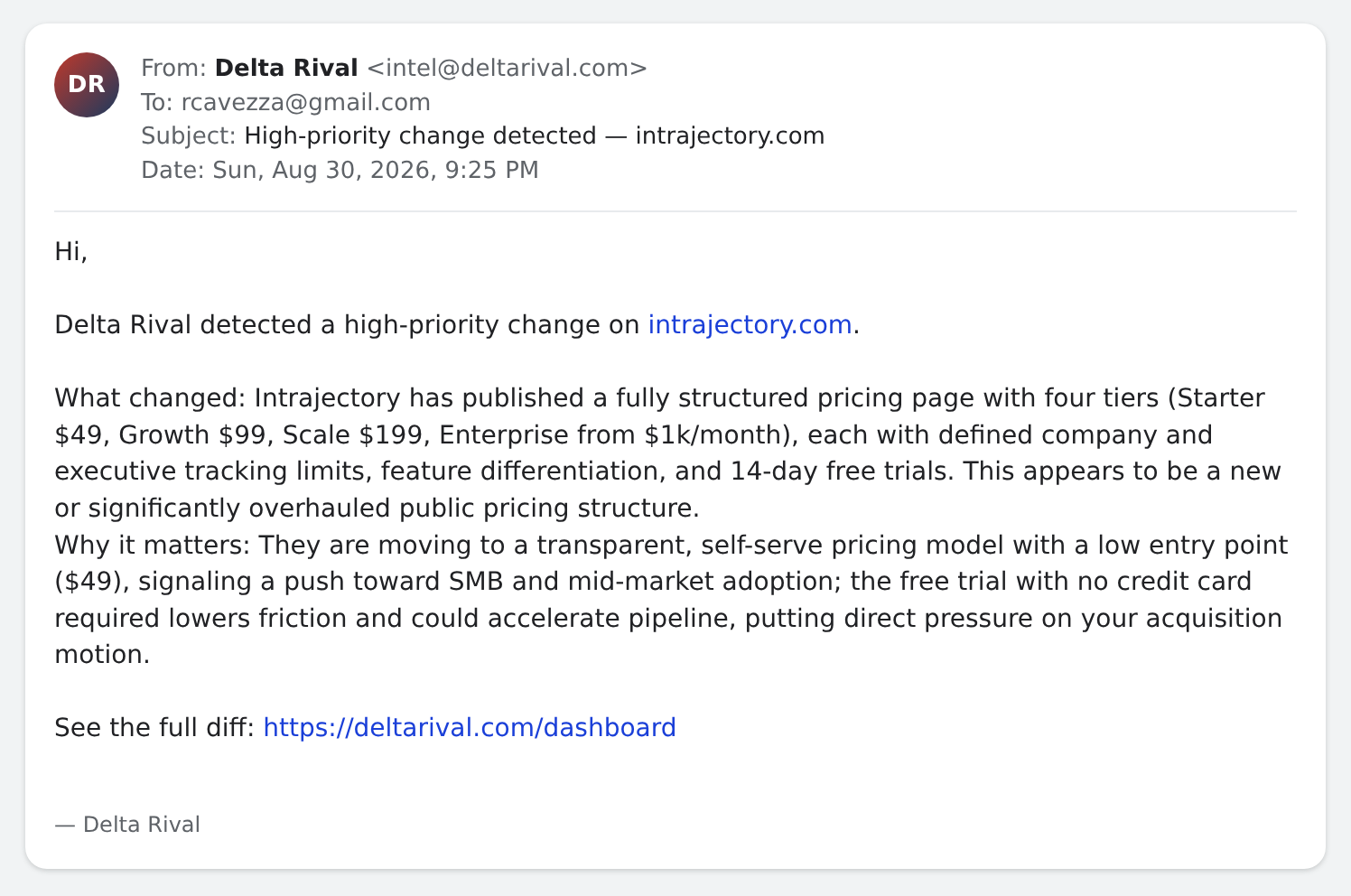
Same-day alert, Aug 30 9:25 PM. Starter $49, Growth $99, Scale $199, 14-day trial.
The point is not that Delta Rival found a secret. The point is that it surfaced a live commercial change quickly enough to matter before the next digest.
Then the next weekly digest did two useful things at once. It kept AlphaSense in the top slot, now with a stronger reason, and it treated TrajectoryAI as the only other competitor showing genuine strategic motion with persona-based SMB positioning, transparent pricing, and a free tier.
That combination matters.
It shows the product can do both jobs: keep the durable market thesis alive over time and interrupt quickly when a pricing or positioning move changes the buying landscape.
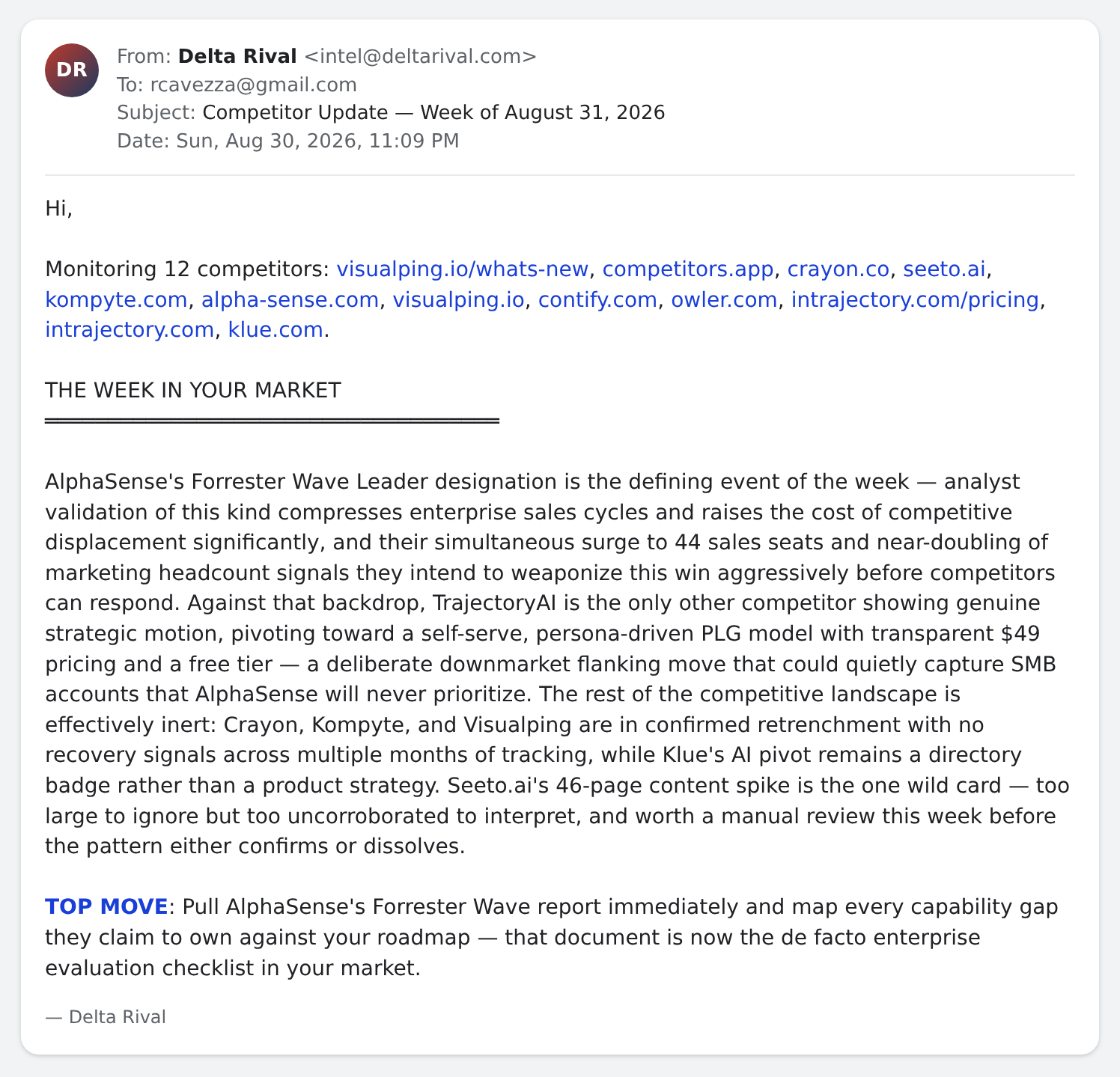
Forrester is the week. TrajectoryAI is the only other competitor actually moving.
The second lesson: most apparent changes are weaker than they look
The strongest credibility signal in these emails was not just that they found one compelling storyline.
It was that they did not invent three more.
The clearest example was competitors.app.
Across multiple updates, Delta Rival treated it as low-signal and uncorroborated rather than forcing a strategic narrative onto weak evidence. That is what I want if the data is thin.
The useful behavior here is not just detection. It is triage.
A founder or small product team usually does not need more alerts. It needs fewer false alarms.
Two other dated signals that were actually useful
The AlphaSense thread was the main story, but the supporting material mattered too because it showed the difference between a real directional signal and a surface-level change.
August 10: Visualping made itself easier to buy
The August 10 digest flagged a major Visualping pricing-page overhaul: clearer plans, clearer limits, more integration detail, and a more self-serve evaluation experience.
That is useful because it changes how quickly a buyer can understand the product without going through sales.
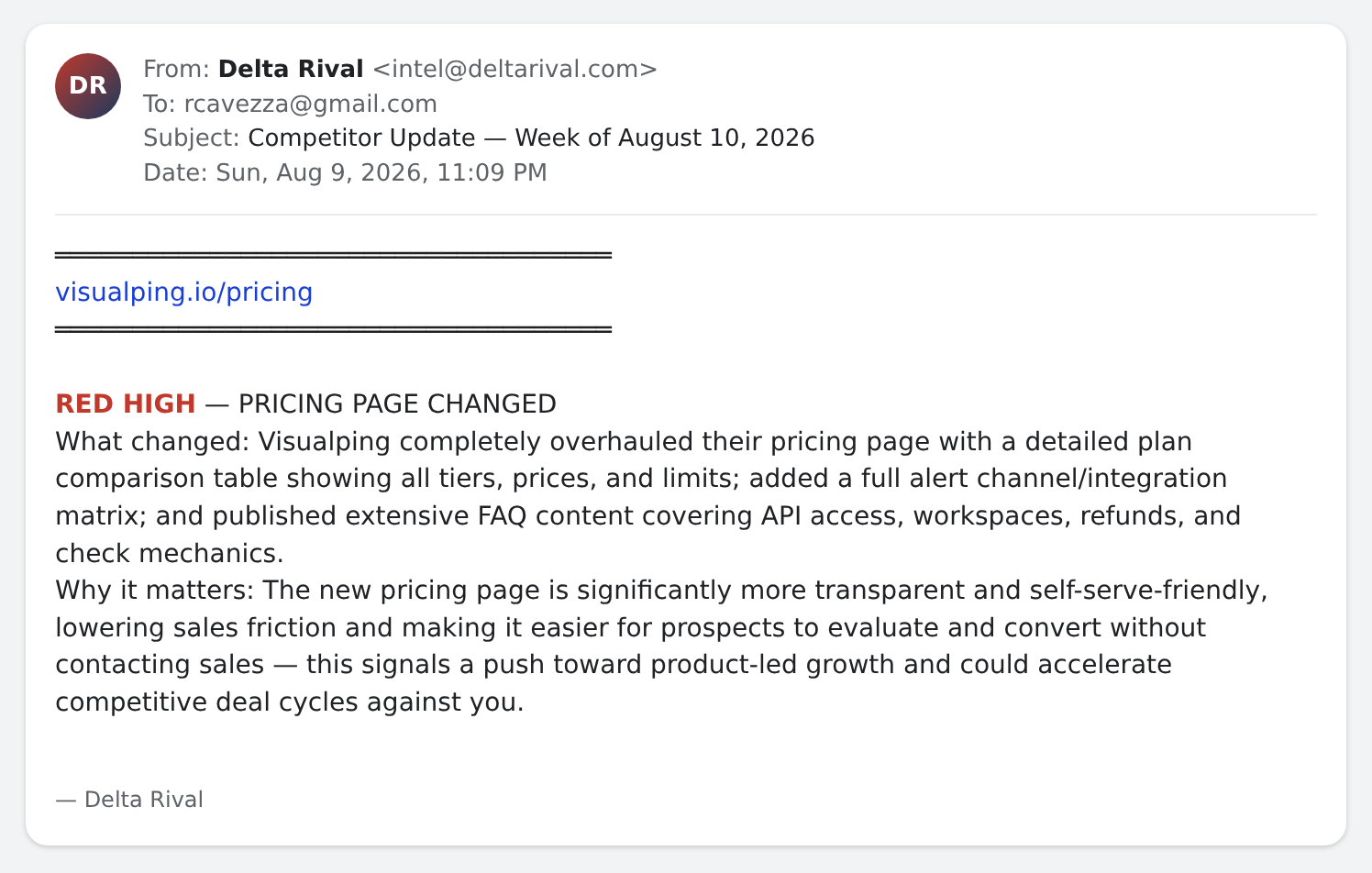
RED HIGH on visualping.io/pricing. Plan table, limits, FAQ. First real PLG tell in weeks.
August 30: Intrajectory became more directly comparable
The same-day August 30 alert was useful for a different reason. It did not just say a page changed. It spelled out a transparent four-tier pricing structure and the 14-day trial, which immediately made Intrajectory more relevant as a direct SMB comparison point.
It also highlighted a real pricing tension instead of hiding it. Intrajectory's $49 entry tier sits below Delta Rival's $79 flat price, but it does so inside a tier ladder with defined limits and an enterprise jump. That is exactly the kind of comparison a founder needs surfaced early: not just who is cheaper at first glance, but how the buying shape is changing underneath the headline number.
That is the kind of alert that changes what I would watch or mention in a sales conversation this week, not next month.
What a founder should take from this
The point of watching competitors is not to become a hobbyist analyst.
It is to make better commercial decisions faster.
If I were a founder reading this sequence, I would take away five practical implications.
- A better-funded incumbent can attack both ends of the market at once. If a competitor is building self-serve entry while adding enterprise sales capacity, you cannot assume they will stay neatly above or below you.
- Buyer-segment pages are usually not content fluff. They often signal an SEO land grab around specific categories, use cases, or buyer language that you may also care about.
- Hiring patterns can confirm or contradict what the website implies. If the copy says one thing and the org chart says another, trust the combination more than either input alone.
- Same-day pricing alerts matter. If a competitor suddenly makes itself easier to buy, waiting for a monthly or quarterly review is too slow.
- Quiet is sometimes the answer. A good monitor should help you ignore the competitors that are not creating new pressure this week.
That last point matters more than most vendors admit.
Where this teardown is still weak
This is still an internal sample, not customer proof.
It also comes from a market where a lot of motion is visible in public. A fair skeptic could say, "Could you have learned some of this by checking a few sites, LinkedIn, and news pages every week?"
Yes, some of it.
But the workflow difference is the point.
The value here was not that Delta Rival uncovered a secret nobody else could ever find. The value was that it kept watching, ranked the week's most important move, connected related signals, surfaced a useful interrupt when speed mattered, and did not make me rebuild the market narrative from scratch every Monday.
That is a real difference for a founder who does not want competitor research to become a part-time job.
What a founder-grade competitor monitor should actually do
After reading these emails in sequence, the bar is clearer.
A competitor monitor for founders should do five things well:
- keep watching without supervision
- rank the one move that matters most this week
- separate corroborated direction from random churn
- interrupt quickly when a pricing or positioning move changes the buying landscape
- end with an implication, not just an archive
When these emails were good, that is what they did.
Closing
The strongest thing Delta Rival found in this test was not a dramatic secret.
It was that across a small but extended sequence, one storyline kept surviving contact with new evidence: AlphaSense appeared to be building a lower-friction funnel and a stronger enterprise motion at the same time. And when another competitor made a more immediate buying-motion move, the alert arrived fast enough to matter.
That is what I want from this category.
Not more competitor data. Better weekly judgment.
If you want to try Delta Rival on your own market, the offer is simple: 14-day free trial, no credit card required. After that it is $79/month, and you can cancel anytime.